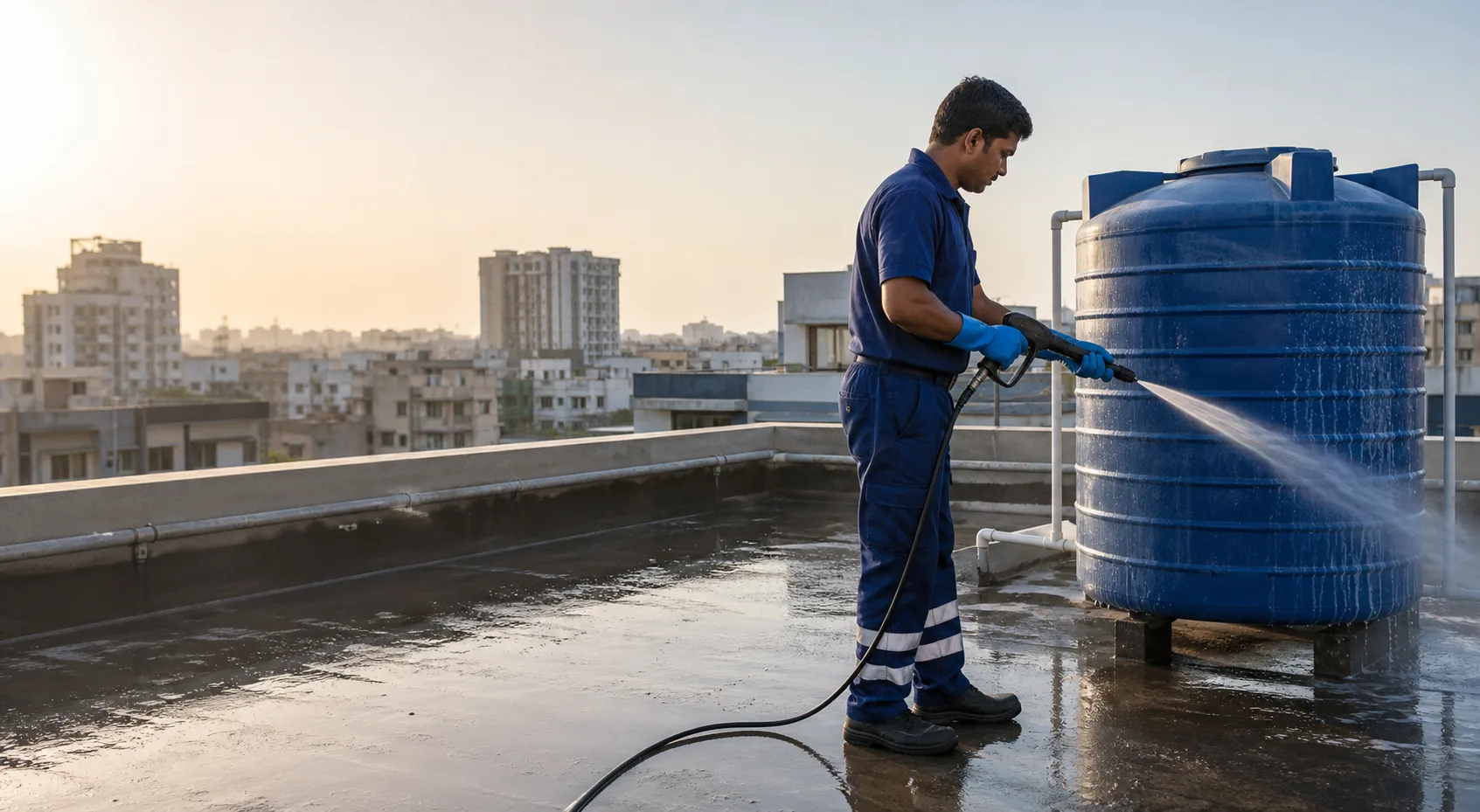
"Tank cleaning" sounds like one job, but an overhead plastic tank on a rooftop, a large underground concrete tank, and a sump each present very different challenges. Knowing the difference helps you ask the right questions and avoid unsafe shortcuts. Here's a clear breakdown.
Overhead tanks
These are the rooftop tanks — usually plastic, sometimes cement — that feed your taps by gravity. Because they sit in the sun, the water warms up, which speeds algae and bacterial growth. They're also the tanks most exposed to dust, leaves and birds if the lid isn't sealed.
- Main risk: algae, warm-water bacteria, and debris entering through gaps.
- Access: often a narrow inlet, so the floor and corners are hard to reach by hand.
- Right method: full drain, mechanical scrubbing of every surface, vacuuming of sediment, and food-grade sanitisation — then checking that the lid and vents seal properly.
See our overhead tank cleaning service for how we handle rooftop tanks safely.
Underground tanks
Underground storage tanks are usually large concrete chambers that hold the bulk of a building's water before it's pumped up to the overhead tank. Their size and depth make them powerful but also more demanding to clean.
- Main risk: heavy sludge and silt settling over a large floor area, plus seepage and cracks letting contaminants in.
- Access: confined-space entry through a manhole — this is where safety matters most.
- Right method: de-watering, sludge removal by vacuum, mechanical wall and floor cleaning, and sanitisation, carried out with proper confined-space precautions.
Learn more about underground tank cleaning.
Sumps
A sump is the ground-level (often partly buried) reservoir that collects the incoming supply. It tends to take the first hit of any silt or contamination in the line, so sediment builds up here quickly.
- Main risk: rapid silt accumulation and standing water that can turn stagnant.
- Access: usually a tight opening at ground level.
- Right method: complete de-sludging, scrubbing and sanitising, with attention to the inlet and foot-valve area.
See sump tank cleaning for details.
The one thing they have in common
Whatever the type, a real clean means emptying it fully, removing the sludge, scrubbing mechanically, and sanitising — never just a rinse.
Manual "splash and drain" cleaning leaves the bio-film and sediment exactly where they cause problems. Mechanised cleaning removes them. It's also why confined-space jobs like underground tanks and sumps should always be left to trained crews with the right equipment — entering a large underground tank without precautions is genuinely dangerous.
Why it matters who does the job
At Hariommhar Enterprises we clean all three types across West Ahmedabad — Bopal, Thaltej, SG Highway, Prahladnagar, Satellite and beyond — from our base in Shilaj. Every eligible job is mechanised, finished with a food-grade sanitiser, and documented with before-and-after photos on WhatsApp. We've been doing this since 2017 and we're GST registered, so you have a proper record for societies and businesses.
Not sure which tank you have or what it needs? Request a quote or get in touch — tell us your tank type and we'll recommend the safest, most thorough approach.
Need your tank cleaned?
Send your tank photos on WhatsApp and our team will confirm the next available slot.